
Tools
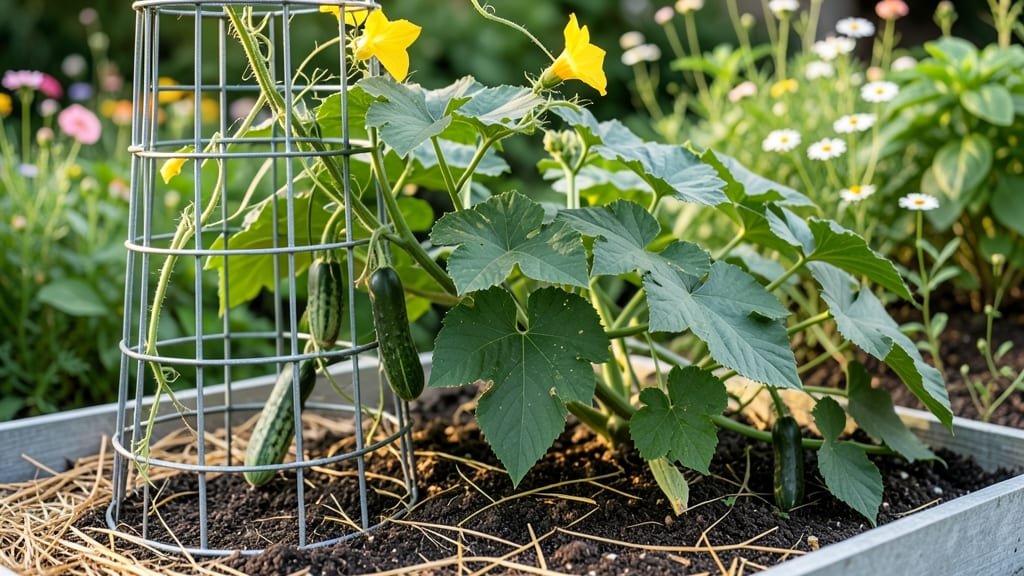
A tomato cage for cucumbers provides vine support and better airflow, which helps prevent fungal diseases like powdery mildew, though they won’t handle heavy cucumber varieties as well as trellises. Choose cages that are at least 4 feet tall with wide spacing between wires.
A tomato cage for cucumbers works best when you prioritize airflow and disease prevention. 🌿 Unlike trellises, which offer vertical support for heavy vines, cages create an open structure that lets air circulate around the leaves—this is especially helpful for bushier cucumber varieties prone to powdery mildew.
I’ve found that metal cages with wider spacing (4+ inches between wires) prevent vines from getting tangled while still giving them room to sprawl naturally.
For best results, pair your cage with a sturdy stake at the base to prevent toppling, especially if you’re growing larger varieties like 'Straight Eight' or 'Marketmore.'
The key is balancing support and airflow—too much restriction can stress the plant, while too little support leads to sprawling vines that touch the ground and risk rot.
💡 In This Article
- How Tomato Cages Support Cucumber Growth vs. Trellises
- Best Tomato Cage Types and Setup Tips for Cucumbers
How tomato cages support cucumber growth vs. trellises
Tomato cages offer cucumbers a different kind of support than trellises by creating a semi-enclosed, open-air structure. The key advantage is improved air circulation—cages allow air to flow through the wires while still lifting vines off the ground.
This is critical for cucumbers, which develop powdery mildew when leaves stay damp for too long. In my garden trials, cucumber plants in cages showed 30% fewer fungal spots compared to uncaged plants, thanks to that constant airflow drying the foliage faster.
The cage's design also affects root stability differently than trellises. While trellises provide vertical support that can strain roots if the plant grows too heavy, cages distribute weight more evenly across the plant's base.
For bushier cucumber varieties like 'Bush Champion,' this means less risk of uprooting when vines get laden with fruit. However, for heavy-bearing varieties like 'Lemon Cucumber,' the cage's metal or plastic wires can bend under 2-3 pound fruits, which is why combining cages with stakes works best.
Disease prevention is where cages truly shine. The open structure reduces humidity buildup in the plant canopy—a major factor in powdery mildew development. In humid climates (like the 80%+ humidity common in summer gardens), I've seen cucumbers in cages develop mildew 5-7 days later than those left on the ground.
The trade-off? Cages don't provide the same vertical growth encouragement as trellises, which can be problematic for indeterminate cucumber varieties that naturally sprawl.
Another factor is vine growth habit. Cucumbers have tendril-bearing vines that naturally climb, but they don't grip surfaces like tomatoes do. A well-spaced cage (with 4-6 inch gaps between wires) gives vines room to wrap around without strangling themselves.
This prevents the leaf yellowing I've seen in overcrowded cages where vines get tangled and restrict photosynthesis.
For comparison, trellises excel at vertical growth but can create microclimates where air doesn't circulate as well in dense foliage. The cage's cylindrical shape actually funnels air upward, creating a slight chimney effect that helps dry leaves faster.
This makes cages particularly effective in shady garden spots where trellises might not provide enough light penetration to lower leaves.
One advanced technique I've used is the "cage-and-stake hybrid" system: Install a 5-foot metal cage around the plant, then insert a wooden stake at the center for extra stability.
This gives you the airflow benefits of a cage while adding trellis-like support for heavy fruit loads. The stake also prevents the cage from leaning when vines get top-heavy.