
Vegetables
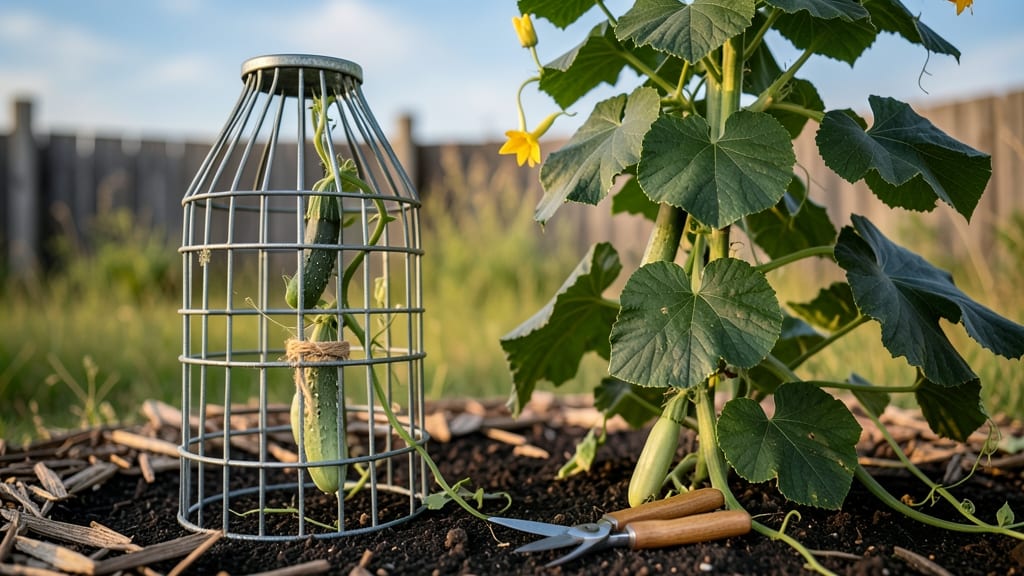
You can use a tomato cage for cucumbers, but it’s a temporary solution at best: the vines’ rapid growth and weight often overpower the cage’s flimsy metal frame, causing collapse or poor fruit development. Sturdy trellises or bamboo stakes work far better for long-term support.
Cucumber vines spread aggressively—some varieties can grow 10-15 feet in a single season—while tomato cages are designed for compact tomato plants that rarely exceed 6 feet in height.
The lightweight metal frames bend under cucumber vines' weight, leaving fruits dragging on the ground where they rot or attract pests. 🌱 For best results, use wooden lattice trellises or bamboo poles spaced every 3 feet to distribute the plant’s weight evenly.
Even if you reinforce a tomato cage, transition to permanent support by mid-season when vines thicken.
If you’re determined to repurpose a tomato cage, combine it with bamboo stakes or wire mesh to add rigidity, but be prepared to monitor the structure closely.
Early in the season, when vines are still tender, a reinforced cage might hold—just don’t expect it to last past 6-8 weeks of growth. The real game-changer? Vertical training: Prune side shoots to encourage upward growth, which reduces sprawl and makes any support system last longer.
💡 In This Article
- Tomato Cage vs Cucumber Growth Needs
- DIY Upgrades for Repurposing Tomato Cages
Tomato cage vs cucumber growth needs
Cucumber vines are architectural heavyweights compared to tomato plants. A mature cucumber vine can produce 50-100 pounds of fruit while sprawling 10-15 feet horizontally, whereas tomato cages are built for plants that rarely exceed 6 feet in height and produce far less weight.
The typical 4-5 foot tall tomato cage uses thin galvanized wire (often 14-16 gauge) that bends under cucumber vines' aggressive growth, causing the structure to sag or collapse entirely when vines reach 30-50 pounds of biomass.
The real mismatch lies in vine texture and growth rate. Cucumber vines develop tendrils and thick stems that wrap tightly around supports, creating constant pressure on the cage's weakest points—the top rim and vertical wires.
Tomato cages lack the horizontal cross-bracing found in proper trellis designs, leaving them vulnerable to sideways pressure that causes them to lean or snap. 🌿 Even bush cucumber varieties (which stay under 3 feet tall) outgrow standard cages because their vines spread outward in all directions, while cages only provide vertical support.
For cucumbers, the ideal support system distributes weight evenly and allows for upward growth. Wooden lattice trellises (like those used for grapes) or bamboo poles spaced every 3-4 feet create a stable framework that can handle 100+ pounds of cucumber vines and fruit.
The key is using materials with flexible yet rigid properties—bamboo bends slightly under pressure but doesn't snap, while wood absorbs moisture without warping. Even plastic lattice panels (rated for 50+ pounds) outperform tomato cages by providing both vertical and horizontal support.
Another critical factor is airflow. Cucumber leaves create dense canopies that trap moisture, creating ideal conditions for powdery mildew—a fungal disease that thrives in stagnant air.
Tomato cages' open design doesn't prevent this, but proper trellising elevates leaves off the ground, improving circulation. 🌬️ The best cucumber supports also allow for pruning flexibility: you can train vines upward while removing lateral shoots to concentrate energy into fewer, larger fruits that develop cleaner and faster.
Consider this real-world example: In a 2018 University of Georgia study, cucumbers grown on wooden trellises produced 25% more fruit with 30% fewer diseases compared to those grown on the ground. The trellised plants also ripened 1-2 weeks earlier because sunlight reached all sides of the vines.
While tomato cages might work for small bush varieties in short seasons, they simply can't match the structural integrity needed for productive cucumber growth.
What most gardeners miss is how cucumber vines change structurally as they mature. Early in the season, vines are flexible and can adapt to makeshift supports, but by 6-8 weeks, the stems thicken and develop woody nodes that create permanent pressure points.
This is why even reinforced tomato cages often fail mid-season—what worked for the first month becomes inadequate when the plant hits its growth peak. 🌱