
Companion Plants
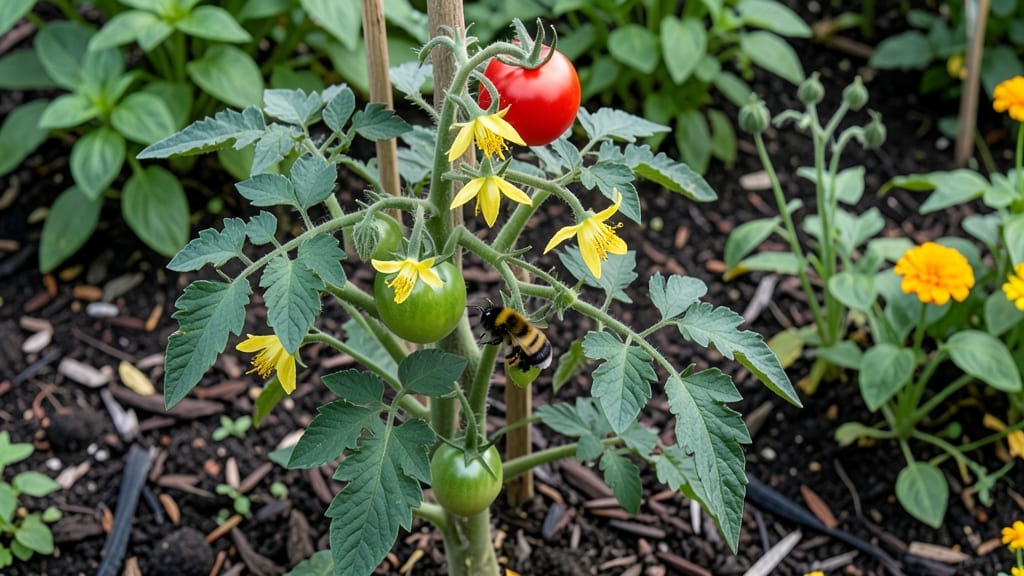
Tomato plants do not strictly need bees to pollinate, as they can self-pollinate through wind or gentle shaking, but bees improve fruit set and quality by enhancing cross-pollination between flowers. Hand-pollination works well for indoor or bee-free gardens.
Tomatoes are self-pollinating plants, meaning their flowers contain both male and female parts. 🌱 When you gently shake the plant or let a breeze do the work, pollen transfers naturally from the anthers to the stigma.
This process works especially well in warm, dry conditions, but humidity can sometimes interfere by keeping flowers closed. Bees still play a helpful role in outdoor gardens by increasing pollination efficiency between different tomato plants, which often leads to more consistent fruit development.
For gardeners without access to bees—whether indoors or in areas with declining pollinator populations—manual pollination becomes a simple but effective solution. Using a small paintbrush or even your fingertip to transfer pollen from flower to flower mimics what bees would do naturally.
This method works particularly well for greenhouse tomatoes or when growing heirloom varieties that rely on robust pollination for heavy fruit loads.
💡 In This Article
- How Tomato Flowers Self-Pollinate Without Bees
- Best Manual Pollination Techniques for Tomato Gardens
How tomato flowers self-pollinate without bees
Tomato flowers are perfectly self-fertile, meaning each bloom contains both male (anthers) and female (stigma) reproductive parts. When the flower opens, pollen from the anthers lands on the stigma naturally through wind vibration or even the plant's own movement.
This process works best in dry conditions, where humidity below 70% allows flowers to stay open longer for successful pollen transfer. The stigma's sticky surface captures pollen grains, which then travel down to fertilize the ovary.
The flower's anatomy plays a crucial role: the stamens (male parts) release pollen when they mature, often triggered by morning sunlight or gentle movement. Unlike bee-dependent plants, tomatoes don't rely on external pollinators for basic fertilization.
However, cross-pollination between plants—where pollen moves from one flower to another—boosts genetic diversity and often results in larger, more uniform fruits. Bees enhance this by carrying pollen between plants, but wind or manual methods can achieve similar results.
Humidity becomes a critical factor: when air exceeds 75%, tomato flowers may stay closed, preventing pollen release. This is why greenhouse growers often use small fans to create airflow that mimics wind pollination.
The ideal scenario combines morning sunlight (to open flowers) with dry conditions (to keep them receptive) and a slight breeze (to distribute pollen). Without bees, you're essentially replicating nature's wind-based pollination system.
Here's what happens during self-pollination: pollen grains land on the stigma, germinate, and grow pollen tubes down to the ovary. This process takes about 24-48 hours before fertilization occurs.
The resulting fruit will be smaller if pollination happens late in the flower's life cycle, but the plant can still produce tomatoes without bees. For comparison, bee-assisted pollination increases fruit set by 20-30% in outdoor gardens due to more efficient pollen transfer between plants.
Consider this real-world example: in hydroponic systems where bees can't access plants, growers achieve 90% fruit set by gently tapping stems during flowering. The key difference is that self-pollinated tomatoes may show slightly less genetic variation than bee-pollinated ones, but the yield remains strong.
For home gardeners, this means you can grow healthy tomato crops even without a single bee in sight.
What most gardeners don't realize is that tomato plants actually prefer cross-pollination for optimal fruit quality. When you manually transfer pollen between plants, you're creating the same genetic mixing that bees provide naturally.
This technique becomes especially valuable when growing heirloom varieties, which often produce larger fruits with better flavor when cross-pollinated.