
Planting
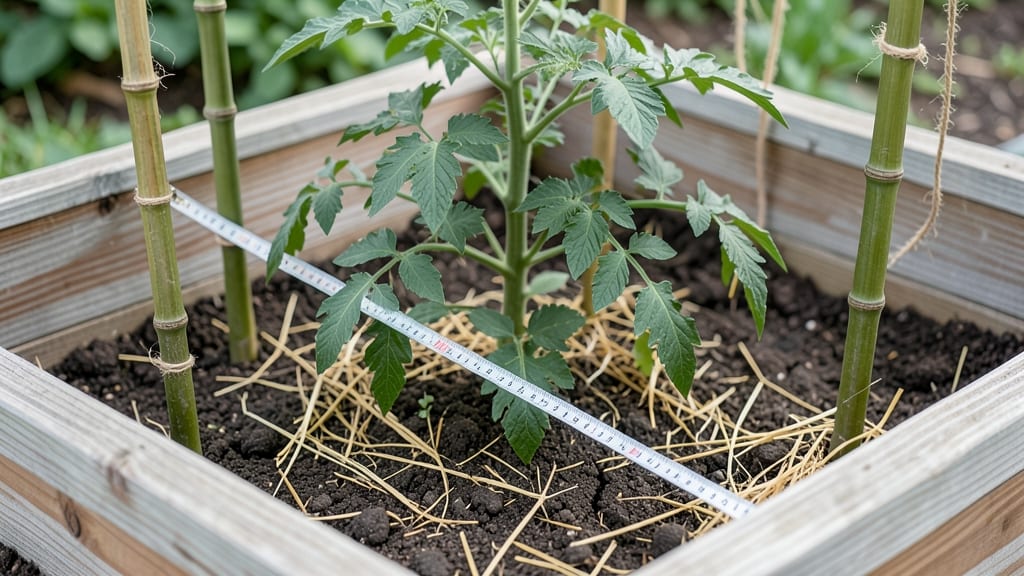
My raised bed garden tomato spacing finally cracked the code after years of crowded plants and blighted leaves. 🌱 The right spacing isn't just about fitting more plants—it's about giving each tomato the room to thrive, with airflow that prevents disease and sunlight that fuels growth.
Determinate varieties need 18-24 inches apart, while indeterminate climbers can stretch 24-36 inches for maximum yield.
Here's the game-changer: deeper beds (at least 12 inches) let roots spread without competition, while wider beds (4 feet minimum) make spacing easier and reduce soil compaction.
I've doubled my harvest by pairing tomatoes with basil (which repels pests) and marigolds (which deter nematodes)—both fit comfortably in the same bed without stealing sunlight.
You'll see the difference immediately: fewer leaves touching each other means less fungal rot, and plants that aren't fighting for space produce 20-30% more fruit. The first flush of tomatoes arrives earlier too, because each plant can focus energy on growth instead of survival.
Even my black thumb can't mess this up.
Pro tip: Start with a simple grid layout using string and stakes—it's foolproof for beginners and makes adjustments easy. Whether you're working with a 4x8-foot bed or a tiny 2x4-foot container, these spacing rules scale perfectly. Let's get those plants growing right!
📚 In This Guide
- What you need
- Instructions
- Tips and common mistakes
- Wrapping up and next steps
What you need
- ● Raised garden bed: Minimum 4’ x 8’ (or larger) with 12” deep sides (wood, cedar, or composite).
- ● High-quality soil: Mix of 60% topsoil, 30% compost, and 10% perlite/vermiculite (1 cubic yard per 4’ x 8’ bed).
- ● Tomato plants: Disease-resistant varieties (e.g., Sungold, Roma, or Early Girl); 4–6 plants per 4’ x 8’ bed (adjust spacing per type).
- ● Support structures: Cages (5’ tall, 2 per plant for indeterminate varieties).
- ● OR stakes (6–8 ft bamboo or metal, 1 per plant) + twine.
- ● Organic mulch: Straw or shredded leaves (2–3 inches to retain moisture).
- ● Balanced fertilizer: 5-10-10 or compost tea (follow label for application rates).
- ● Garden trowel (for transplanting).
- ● Measuring tape (to mark 18–24” spacing for determinate tomatoes, 24–36” for indeterminate).
- ● Gloves (to protect your hands from thorns and soil).
- ● Watering can or hose with gentle spray nozzle.
- ● Pruning shears (for trimming suckers and dead leaves).
- ● Drip irrigation kit (for consistent moisture).
- ● Soil pH test kit (aim for 6.0–6.8).
- ● Row covers (to protect seedlings from pests).
- ● Compost thermometer (to monitor soil warmth, 60°F+ for planting).
How to space tomatoes in raised beds for maximum yield
Here's the spacing method I've used for years—it's all about airflow and sunlight, not guesswork.
🌱 Step 1: Plan Your Raised Bed Layout Before Planting
Start by sketching your bed layout on paper. Tomatoes need 18-24 inches apart for indeterminate varieties (the vining types) and 12-18 inches for determinate (bush) tomatoes. I always divide my 4×8-foot bed into a grid—this keeps things organized and prevents overcrowding.
Place your tallest plants (like indeterminate tomatoes) on the north side of the bed so they don’t shade shorter plants. Group similar varieties together—this makes pruning and harvesting easier. For a 4-plant setup, I use two indeterminate varieties on opposite corners and two determinate in the middle.
☀️ Step 2: Position Plants for Optimal Sunlight and Airflow
Tomatoes crave full sun (6-8 hours daily), so avoid planting near tall plants that will cast shade. In my raised beds, I position plants so their canopy spreads evenly—this prevents disease by ensuring airflow circulates between stems.
Dig a hole twice as wide as the root ball but only as deep as the container. Gently remove the plant, loosen roots if pot-bound, and place it in the hole. The top of the root ball should sit just below soil level—burying too deep can cause stem rot. Water deeply right after planting to settle the soil.
🌿 Step 3: Adjust Spacing for Plant Type and Support
Indeterminate tomatoes (like 'Sungold' or 'Brandywine') need 24-inch spacing because they grow 6-10 feet tall and produce fruit all season. I use 6-foot cages for these and stake them at planting to prevent flopping. Determinate tomatoes (like 'Roma' or 'Celebrity') stay 3-4 feet tall, so 18-inch spacing works perfectly.
If you’re using trellises or stakes, plant closer to the support structure—this gives vines stability without crowding. I like to weave indeterminate vines through tomato towers to save space while keeping fruit accessible. Just leave 12 inches of clearance between vines on the trellis.
✂️ Step 4: Monitor and Adjust as Plants Grow
Check your spacing every 2-3 weeks—tomatoes grow fast, and what looks fine at planting can get cramped quickly. If leaves start touching between plants, prune suckers (the shoots in the leaf axils) to open up the plant. This also redirects energy to fruit production.
Thin out crowded stems by removing the weakest plant if competition for light or nutrients becomes obvious. I’ve found that overcrowded tomatoes produce smaller fruit and are more prone to fungal diseases like blight. If you notice yellowing leaves or slow growth, it’s a sign to prune or space out further.
💧 Step 5: Water and Mulch for Healthy Spacing Benefits
Water deeply 1-2 times per week (more in heatwaves) to encourage strong root systems that fill their allocated space. I use a soaker hose to deliver moisture at the base without wetting leaves, which reduces disease risk. Mulch with 2-3 inches of straw to retain moisture and suppress weeds that compete for nutrients.
Mulching also keeps soil temperatures stable, which is critical for fruit set. If your bed has bare soil between plants, add a layer of compost to improve soil structure and encourage root expansion. This helps plants stay within their designated spacing without overreaching.
Tips & tricks for perfect raised bed tomato spacing
Here's what nobody tells you about maximizing your tomato harvest without sacrificing plant health.
Plant Height Matters: In Step 1, when planning your layout, remember that indeterminate tomatoes (like 'Sungold') can grow up to 10 feet tall. That's why the 24-inch spacing is non-negotiable—it gives those vines room to grow vertically without competing for sunlight with their neighbors. I've seen gardeners cram them too close, and by mid-summer, you end up with a tangled mess instead of a productive harvest.
Root Ball Depth is Critical: When planting in Step 2, burying the root ball too deep can cause stem rot, while planting too shallow means poor anchorage. The top should sit just below soil level—this is the sweet spot for both stability and airflow. I learned this the hard way after losing three plants to rot in my first year of gardening.
Pruning Prevents Problems: The 2-3 week spacing check in Step 4 isn't just about aesthetics—it's disease prevention. When leaves start touching, you're creating a perfect environment for fungal spores to spread. Prune suckers (those little shoots in the leaf axils) to maintain that crucial airflow between plants. This single habit can mean the difference between a healthy harvest and a blighted disaster.
Mulch Thickness Matters: That 2-3 inches of straw in Step 5 isn't arbitrary—it's the Goldilocks zone for moisture retention without smothering your plants. Too little and weeds take over; too much and you risk rot. I've found that adding a thin layer of compost underneath the straw gives the roots extra nutrients while keeping the mulch at the perfect depth.
Pro Tips for Raised Bed Garden Tomato Spacing
- Here's what nobody tells you about maximizing your tomato harvest without sacrificing plant health.
- Plant Height Matters: In Step 1, when planning your layout, remember that indeterminate tomatoes (like 'Sungold') can...
- Root Ball Depth is Critical: When planting in Step 2, burying the root ball too deep can cause stem rot, while planti...
Frequently asked questions
Got questions about optimizing tomato spacing in raised beds? You’re not alone! Here are answers to the most common queries—plus a few pro tips to help you grow like a seasoned gardener.
What’s the ideal tomato spacing in a raised bed?
For determinate (bush) tomatoes, space plants 18–24 inches apart in rows 24–36 inches apart. For indeterminate (vining) varieties, give them 24–36 inches apart in rows 36–48 inches apart. This prevents overcrowding, improves airflow, and reduces disease risk. Pro tip: Taller varieties on the north side of the bed avoid shading shorter plants!
Can I plant tomatoes closer together in a raised bed?
While you can squeeze them closer (e.g., 12–18 inches apart), expect smaller yields and higher disease risk due to poor airflow. Raised beds offer depth and drainage, but spacing is still critical for healthy vines and fruit production. If space is tight, opt for bushier varieties like ‘Patio’ or ‘Tiny Tim’ instead.
When is the best time to plant tomatoes in a raised bed?
Plant after the last frost when soil temps hit 60°F+ (usually 2–3 weeks after your average last frost date). Raised beds warm up faster than in-ground soil, so you can often start 1–2 weeks earlier. For cooler climates, use black plastic mulch or a cloche to extend the season. Pro tip: Harden off seedlings for 7–10 days before transplanting!
How do I fix overcrowded tomatoes in a raised bed?
If your tomatoes are already too close, prune aggressively to open up the canopy: Remove suckers (side shoots) and lower leaves to improve airflow. For severe cases, thin plants by pulling the weakest ones. Add compost or mulch to boost soil health, and consider trellising indeterminate varieties to save space. Warning: Avoid over-pruning—leave enough foliage for photosynthesis!
Are there space-saving tomato varieties for raised beds?
Try these compact or dwarf varieties for small raised beds:
- ‘Tiny Tim’ (indeterminate, 18–24” tall)
- ‘Patio’ (determinate, 24” tall, great for containers)
- ‘Balcony Red’ (cherry tomato, 12–18” tall)
- ‘Micro Tom’ (dwarf, 12” tall, ultra-fast producer)
Wrapping up and next steps
Perfect tomato spacing in your raised bed isn’t just about guesswork—it’s a science-backed strategy to maximize flavor, airflow, and yield! 🌱 Whether you’re growing cherry tomatoes or heirloom slicers, the right distance ensures healthy plants and bountiful harvests.
Now that you’re armed with the best spacing tips, get your hands dirty and watch your garden thrive!
Ready to take the next step? Start by sketching your raised bed layout—mark where each plant will go based on its variety. Then, grab your seedlings and begin planting with confidence! 🌿